
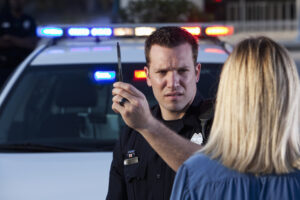
Field sobriety tests are often portrayed as objective, scientific tools for determining intoxication.
They are not.
In Orange County DUI cases, roadside field sobriety tests are highly subjective, heavily influenced by environmental conditions, and dependent on officer interpretation. Yet prosecutors frequently rely on them to justify arrests and support criminal charges.
Understanding how these tests work — and how they can be challenged — is critical in serious DUI defense.
What Are Field Sobriety Tests?
When an officer suspects a driver of impairment, they may request that the driver perform a series of roadside exercises. The most common standardized field sobriety tests include:
- Horizontal Gaze Nystagmus (HGN) – Observing involuntary eye movement.
- Walk-and-Turn – Taking heel-to-toe steps along a straight line.
- One-Leg Stand – Balancing on one foot while counting aloud.
Officers are trained to look for specific “clues” of impairment during these exercises. The more clues observed, the more likely the officer will conclude the driver is impaired.
However, these tests are not foolproof — and they are not required by law in most situations.
Field Sobriety Tests Are Voluntary in California
Many drivers are unaware that roadside field sobriety tests are generally voluntary in California. Unlike chemical testing after arrest (which falls under implied consent laws), you are not legally required to perform balancing or coordination exercises before being taken into custody.
Despite this, officers often present these tests as mandatory, and drivers comply without understanding the consequences.
Participation can provide additional evidence that may later be used against you — even if your blood alcohol concentration is below the legal limit.
The Problem With “Standardization”
While these tests are labeled “standardized,” real-world conditions rarely meet ideal testing environments.
In Orange County DUI stops, factors that can affect performance include:
- Uneven pavement
- Sloped road shoulders
- Gravel or debris
- Flashing patrol car lights
- Passing traffic
- Weather conditions
- Improper footwear
Even perfectly sober individuals may struggle under these conditions.
Medical & Physical Conditions That Mimic Impairment
Field sobriety tests assume a baseline level of physical coordination. They do not account for common medical conditions that can interfere with performance.
Conditions that can affect results include:
- Inner ear disorders
- Vertigo
- Back or knee injuries
- Neurological conditions
- Anxiety disorders
- Age-related balance limitations
- Fatigue
Even body type and natural coordination levels can influence perceived “clues.”
Without careful cross-examination, these factors may never be presented to a jury.
Officer Subjectivity & Confirmation Bias
Field sobriety tests are evaluated by the same officer who initiated the stop.
If an officer already suspects impairment — due to odor of alcohol, admission of drinking, or minor driving behavior — they may unconsciously interpret ambiguous movements as signs of intoxication.
Small missteps, momentary balance adjustments, or misunderstood instructions can be recorded as “clues.”
Body camera footage often tells a different story than written police reports.
Challenging inconsistencies between video evidence and officer testimony can be a critical defense strategy.
How Field Sobriety Tests Are Challenged in Orange County DUI Cases
Effective DUI defense requires careful review of:
- Body-worn camera footage
- Dash camera recordings
- Officer training records
- Compliance with National Highway Traffic Safety Administration (NHTSA) guidelines
- Environmental conditions at the scene
If procedures were not properly followed, the reliability of the test results may be undermined.
In some cases, defense attorneys may file motions to suppress evidence if the initial stop lacked reasonable suspicion or if arrest procedures violated constitutional protections.
When field sobriety tests form the primary basis for probable cause, attacking their reliability can significantly weaken the prosecution’s case.
Field Sobriety Tests Alone Do Not Prove Guilt
It is important to understand that field sobriety tests are not definitive proof of intoxication.
They are investigative tools — nothing more.
A DUI conviction requires proof beyond a reasonable doubt. Subjective roadside exercises conducted under imperfect conditions do not automatically meet that standard.
In serious DUI cases — especially those involving professionals, commercial drivers, or high-stakes consequences — roadside evidence must be scrutinized carefully and strategically.
Serious DUI Defense in Orange County Requires Experience
If you were arrested after performing field sobriety tests in Orange County, those roadside exercises may now form a central part of the prosecution’s case.
The attorneys at Simmons & Wagner are Former Orange County Deputy District Attorneys who understand how DUI investigations are built — and how field sobriety evidence is presented in court. That experience provides valuable insight when challenging subjective roadside testing.
If your license, career, or freedom is at risk, contact Simmons & Wagner immediately to discuss your DUI defense options in Orange County.